
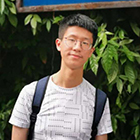
Licheng Wen
MS Student
Institute of Cyber-Systems and Control, Zhejiang University, China
Biography
I am currently a M.S. degree candidate of the institute of Cyber Systems and Control, Department of Control Science and Engineering, Zhejiang University. I received his B.S. degree in College of Control Science and Engineering from Zhejiang University in 2019. My latest research interests include robotics and motion planning.
Research and Interests
- Motion Planning
Publications
- Yukai Ma, Tiantian Wei, Naiting Zhong, Jianbiao Mei, Tao Hu, Licheng Wen, Xuemeng Yang, Botian Shi, and Yong Liu. LeapVAD: A Leap in Autonomous Driving via Cognitive Perception and Dual-Process Thinking. IEEE Transactions on Neural Networks and Learning System, 2025.
[BibTeX] [Abstract] [DOI]While autonomous driving technology has made remarkable strides, data-driven approaches still struggle with complex scenarios due to their limited reasoning capabilities. Meanwhile, knowledge-driven autonomous driving systems have evolved considerably with the popularization of visual language models. In this article, we propose LeapVAD, a novel method based on cognitive perception and dual-process thinking. Our approach implements a human-attentional mechanism to identify and focus on critical traffic elements that influence driving decisions. By characterizing these objects through comprehensive attributes—including appearance, motion patterns, and associated risks—LeapVAD achieves more effective environmental representation and streamlines the decision-making process. Furthermore, LeapVAD incorporates an innovative dual-process decision-making module mimicking the human-driving learning process. The system consists of an analytic process (System-II) that accumulates driving experience through logical reasoning and a heuristic process (System-I) that refines this knowledge via fine-tuning and few-shot learning. LeapVAD also includes reflective mechanisms and a growing memory bank, enabling it to learn from past mistakes and continuously improve its performance in a closed-loop environment. To enhance efficiency, we develop a scene encoder network that generates compact scene representations for rapid retrieval of relevant driving experiences. Extensive evaluations conducted on two leading autonomous driving simulators, CARLA and DriveArena, demonstrate that LeapVAD achieves superior performance compared with camera-only approaches despite limited training data. Comprehensive ablation studies further emphasize its effectiveness in continuous learning and domain adaptation. Project page: https://pjlab-adg.github.io/LeapVAD/
@article{ma2025leap, title = {LeapVAD: A Leap in Autonomous Driving via Cognitive Perception and Dual-Process Thinking}, author = {Yukai Ma and Tiantian Wei and Naiting Zhong and Jianbiao Mei and Tao Hu and Licheng Wen and Xuemeng Yang and Botian Shi and Yong Liu}, year = 2025, journal = {IEEE Transactions on Neural Networks and Learning System}, doi = {10.1109/TNNLS.2025.3626711}, abstract = {While autonomous driving technology has made remarkable strides, data-driven approaches still struggle with complex scenarios due to their limited reasoning capabilities. Meanwhile, knowledge-driven autonomous driving systems have evolved considerably with the popularization of visual language models. In this article, we propose LeapVAD, a novel method based on cognitive perception and dual-process thinking. Our approach implements a human-attentional mechanism to identify and focus on critical traffic elements that influence driving decisions. By characterizing these objects through comprehensive attributes—including appearance, motion patterns, and associated risks—LeapVAD achieves more effective environmental representation and streamlines the decision-making process. Furthermore, LeapVAD incorporates an innovative dual-process decision-making module mimicking the human-driving learning process. The system consists of an analytic process (System-II) that accumulates driving experience through logical reasoning and a heuristic process (System-I) that refines this knowledge via fine-tuning and few-shot learning. LeapVAD also includes reflective mechanisms and a growing memory bank, enabling it to learn from past mistakes and continuously improve its performance in a closed-loop environment. To enhance efficiency, we develop a scene encoder network that generates compact scene representations for rapid retrieval of relevant driving experiences. Extensive evaluations conducted on two leading autonomous driving simulators, CARLA and DriveArena, demonstrate that LeapVAD achieves superior performance compared with camera-only approaches despite limited training data. Comprehensive ablation studies further emphasize its effectiveness in continuous learning and domain adaptation. Project page: https://pjlab-adg.github.io/LeapVAD/} } - Yukai Ma, Jianbiao Mei, Xuemeng Yang, Licheng Wen, Weihua Xu, Jiangning Zhang, Xingxing Zuo, Botian Shi, and Yong Liu. LiCROcc: Teach Radar for Accurate Semantic Occupancy Prediction using LiDAR and Camera. IEEE Robotics and Automation Letters, 10:852-859, 2025.
[BibTeX] [Abstract] [DOI] [PDF]Semantic Scene Completion (SSC) is pivotal in autonomous driving perception, frequently confronted with the complexities of weather and illumination changes. The long-term strategy involves fusing multi-modal information to bolster the system’s robustness. Radar, increasingly utilized for 3D target detection, is gradually replacing LiDAR in autonomous driving applications, offering a robust sensing alternative. In this letter, we focus on the potential of 3D radar in semantic scene completion, pioneering cross-modal refinement techniques for improved robustness against weather and illumination changes and enhancing SSC performance. Regarding model architecture, we propose a threestage tight fusion approach on BEV to realize a fusion framework for point clouds and images. Based on this foundation, we designed three cross-modal distillation modules—CMRD, BRD, and PDD. Our approach enhances the performance in radar-only (R-LiCROcc) and radar-camera (RC-LiCROcc) settings by distilling to them the rich semantic and structural information of the fused features of LiDAR and camera. Finally, our LC-Fusion, R-LiCROcc and RC-LiCROcc achieve the best performance on the nuScenes-Occupancy dataset, with mIOU exceeding the baseline by 22.9%, 44.1%, and 15.5%, respectively.
@article{ma2025locro, title = {LiCROcc: Teach Radar for Accurate Semantic Occupancy Prediction using LiDAR and Camera}, author = {Yukai Ma and Jianbiao Mei and Xuemeng Yang and Licheng Wen and Weihua Xu and Jiangning Zhang and Xingxing Zuo and Botian Shi and Yong Liu}, year = 2025, journal = {IEEE Robotics and Automation Letters}, volume = 10, pages = {852-859}, doi = {10.1109/LRA.2024.3511427}, abstract = {Semantic Scene Completion (SSC) is pivotal in autonomous driving perception, frequently confronted with the complexities of weather and illumination changes. The long-term strategy involves fusing multi-modal information to bolster the system’s robustness. Radar, increasingly utilized for 3D target detection, is gradually replacing LiDAR in autonomous driving applications, offering a robust sensing alternative. In this letter, we focus on the potential of 3D radar in semantic scene completion, pioneering cross-modal refinement techniques for improved robustness against weather and illumination changes and enhancing SSC performance. Regarding model architecture, we propose a threestage tight fusion approach on BEV to realize a fusion framework for point clouds and images. Based on this foundation, we designed three cross-modal distillation modules—CMRD, BRD, and PDD. Our approach enhances the performance in radar-only (R-LiCROcc) and radar-camera (RC-LiCROcc) settings by distilling to them the rich semantic and structural information of the fused features of LiDAR and camera. Finally, our LC-Fusion, R-LiCROcc and RC-LiCROcc achieve the best performance on the nuScenes-Occupancy dataset, with mIOU exceeding the baseline by 22.9%, 44.1%, and 15.5%, respectively.} } - Jianbiao Mei, Yukai Ma, Xuemeng Yang, Licheng Wen, Xinyu Cai, Xin Li, Daocheng Fu, Bo Zhang, Pinlong Cai, Min Dou, Botian Shi, Liang He, Yong Liu, and Yu Qiao. Continuously Learning, Adapting, and Improving: A Dual-Process Approach to Autonomous Driving. In 38th Conference on Neural Information Processing Systems (NeurIPS), 2024.
[BibTeX] [Abstract]Autonomous driving has advanced significantly due to sensors, machine learning, and artificial intelligence improvements. However, prevailing methods struggle with intricate scenarios and causal relationships, hindering adaptability and interpretability in varied environments. To address the above problems, we introduce LeapAD, a novel paradigm for autonomous driving inspired by the human cognitive process. Specifically, LeapAD emulates human attention by selecting critical objects relevant to driving decisions, simplifying environmental interpretation, and mitigating decision-making complexities. Additionally, LeapAD incorporates an innovative dual-process decision-making module, which consists of an Analytic Process (System-II) for thorough analysis and reasoning, along with a Heuristic Process (System-I) for swift and empirical processing. The Analytic Process leverages its logical reasoning to accumulate linguistic driving experience, which is then transferred to the Heuristic Process by supervised fine-tuning. Through reflection mechanisms and a growing memory bank, LeapAD continuously improves itself from past mistakes in a closed-loop environment. Closed-loop testing in CARLA shows that LeapAD outperforms all methods relying solely on camera input, requiring 1-2 orders of magnitude less labeled data. Experiments also demonstrate that as the memory bank expands, the Heuristic Process with only 1.8B parameters can inherit the knowledge from a GPT-4 powered Analytic Process and achieve continuous performance improvement. Project page: https://pjlab-adg.github.io/LeapAD/.
@inproceedings{mei2024cla, title = {Continuously Learning, Adapting, and Improving: A Dual-Process Approach to Autonomous Driving}, author = {Jianbiao Mei and Yukai Ma and Xuemeng Yang and Licheng Wen and Xinyu Cai and Xin Li and Daocheng Fu and Bo Zhang and Pinlong Cai and Min Dou and Botian Shi and Liang He and Yong Liu and Yu Qiao}, year = 2024, booktitle = {38th Conference on Neural Information Processing Systems (NeurIPS)}, abstract = {Autonomous driving has advanced significantly due to sensors, machine learning, and artificial intelligence improvements. However, prevailing methods struggle with intricate scenarios and causal relationships, hindering adaptability and interpretability in varied environments. To address the above problems, we introduce LeapAD, a novel paradigm for autonomous driving inspired by the human cognitive process. Specifically, LeapAD emulates human attention by selecting critical objects relevant to driving decisions, simplifying environmental interpretation, and mitigating decision-making complexities. Additionally, LeapAD incorporates an innovative dual-process decision-making module, which consists of an Analytic Process (System-II) for thorough analysis and reasoning, along with a Heuristic Process (System-I) for swift and empirical processing. The Analytic Process leverages its logical reasoning to accumulate linguistic driving experience, which is then transferred to the Heuristic Process by supervised fine-tuning. Through reflection mechanisms and a growing memory bank, LeapAD continuously improves itself from past mistakes in a closed-loop environment. Closed-loop testing in CARLA shows that LeapAD outperforms all methods relying solely on camera input, requiring 1-2 orders of magnitude less labeled data. Experiments also demonstrate that as the memory bank expands, the Heuristic Process with only 1.8B parameters can inherit the knowledge from a GPT-4 powered Analytic Process and achieve continuous performance improvement. Project page: https://pjlab-adg.github.io/LeapAD/.} } - Yuchen Wu, Yifan Yang, Gang Xu, Junjie Cao, Yansong Chen, Licheng Wen, and Yong Liu. Hierarchical Search-Based Cooperative Motion Planning. In 2024 IEEE/RSJ International Conference on Intelligent Robots and Systems (IROS), pages 8055-8062, 2024.
[BibTeX] [Abstract] [DOI] [PDF]Cooperative path planning, a crucial aspect of multi-agent systems research, serves a variety of sectors, including military, agriculture, and industry. Many existing algorithms, however, come with certain limitations, such as simplified kinematic models and inadequate support for multiple group scenarios. Focusing on the planning problem associated with a nonholonomic Ackermann model for Unmanned Ground Vehicles (UGV), we propose a leaderless, hierarchical Search-Based Cooperative Motion Planning (SCMP) method. The high-level utilizes a binary conflict search tree to minimize runtime, while the low-level fabricates kinematically feasible, collision-free paths that are shape-constrained. Our algorithm can adapt to scenarios featuring multiple groups with different shapes, outlier agents, and elaborate obstacles. We conduct algorithm comparisons, performance testing, simulation, and real-world testing, verifying the effectiveness and applicability of our algorithm. The implementation of our method will be open-sourced at https://github.com/WYCUniverStar/SCMP.
@inproceedings{wu2024hsb, title = {Hierarchical Search-Based Cooperative Motion Planning}, author = {Yuchen Wu and Yifan Yang and Gang Xu and Junjie Cao and Yansong Chen and Licheng Wen and Yong Liu}, year = 2024, booktitle = {2024 IEEE/RSJ International Conference on Intelligent Robots and Systems (IROS)}, pages = {8055-8062}, doi = {10.1109/IROS58592.2024.10801442}, abstract = {Cooperative path planning, a crucial aspect of multi-agent systems research, serves a variety of sectors, including military, agriculture, and industry. Many existing algorithms, however, come with certain limitations, such as simplified kinematic models and inadequate support for multiple group scenarios. Focusing on the planning problem associated with a nonholonomic Ackermann model for Unmanned Ground Vehicles (UGV), we propose a leaderless, hierarchical Search-Based Cooperative Motion Planning (SCMP) method. The high-level utilizes a binary conflict search tree to minimize runtime, while the low-level fabricates kinematically feasible, collision-free paths that are shape-constrained. Our algorithm can adapt to scenarios featuring multiple groups with different shapes, outlier agents, and elaborate obstacles. We conduct algorithm comparisons, performance testing, simulation, and real-world testing, verifying the effectiveness and applicability of our algorithm. The implementation of our method will be open-sourced at https://github.com/WYCUniverStar/SCMP.} } - Weiwei Liu, Linpeng Peng, Licheng Wen, Jian Yang, and Yong Liu. Decomposing Shared Networks for Separate Cooperation with Multi-agent Reinforcement Learning. Information Sciences, 641:119085, 2023.
[BibTeX] [Abstract] [DOI] [PDF]Sharing network parameters between agents is an essential and typical operation to improve the scalability of multi-agent reinforcement learning algorithms. However, agents with different tasks sharing the same network parameters are not conducive to distinguishing the agents’ skills. In addition, the importance of communication between agents undertaking the same task is much higher than that with external agents. Therefore, we propose Dual Cooperation Networks (DCN). In order to distinguish whether agents undertake the same task, all agents are grouped according to their status through the graph neural network instead of the traditional proximity. The agent communicates within the group to achieve strong cooperation. After that, the global value function is decomposed by groups to facilitate cooperation between groups. Finally, we have verified it in simulation and physical hardware, and the algorithm has achieved excellent performance.
@article{liu2023dsn, title = {Decomposing Shared Networks for Separate Cooperation with Multi-agent Reinforcement Learning}, author = {Weiwei Liu and Linpeng Peng and Licheng Wen and Jian Yang and Yong Liu}, year = 2023, journal = {Information Sciences}, volume = 641, pages = {119085}, doi = {10.1016/j.ins.2023.119085}, abstract = {Sharing network parameters between agents is an essential and typical operation to improve the scalability of multi-agent reinforcement learning algorithms. However, agents with different tasks sharing the same network parameters are not conducive to distinguishing the agents' skills. In addition, the importance of communication between agents undertaking the same task is much higher than that with external agents. Therefore, we propose Dual Cooperation Networks (DCN). In order to distinguish whether agents undertake the same task, all agents are grouped according to their status through the graph neural network instead of the traditional proximity. The agent communicates within the group to achieve strong cooperation. After that, the global value function is decomposed by groups to facilitate cooperation between groups. Finally, we have verified it in simulation and physical hardware, and the algorithm has achieved excellent performance.} } - Licheng Wen, Yong Liu, and Hongliang Li. CL-MAPF: Multi-Agent Path Finding for Car-Like Robots with Kinematic and Spatiotemporal Constraints. Robotics and Autonomous Systems, 150, 2022.
[BibTeX] [Abstract] [DOI] [PDF]Multi-Agent Path Finding has been widely studied in the past few years due to its broad application in the field of robotics and AI. However, previous solvers rely on several simplifying assumptions. This limits their applicability in numerous real-world domains that adopt nonholonomic car-like agents rather than holonomic ones. In this paper, we give a mathematical formalization of the Multi-Agent Path Finding for Car-Like robots (CL-MAPF) problem. We propose a novel hierarchical search-based solver called Car-Like Conflict-Based Search to address this problem. It applies a body conflict tree to address collisions considering the shapes of the agents. We introduce a new algorithm called Spatiotemporal Hybrid-State A* as the single-agent planner to generate agents’ paths satisfying both kinematic and spatiotemporal constraints. We also present a sequential planning version of our method, sacrificing a small amount of solution quality to achieve a significant reduction in runtime. We compare our method with two baseline algorithms on a dedicated benchmark and validate it in real-world scenarios. The experiment results show that the planning success rate of both baseline algorithms is below 50% for all six scenarios, while our algorithm maintains that of over 98%. It also gives clear evidence that our algorithm scales well to 100 agents in 300 m x 300 m scenario and is able to produce solutions that can be directly applied to Ackermann-steering robots in the real world. The benchmark and source code are released in https://github.com/APRIL-ZJU/CL-CBS. The video of the experiments can be found on YouTube.(C) 2021 Elsevier B.V. All rights reserved.
@article{wen2022clm, title = {CL-MAPF: Multi-Agent Path Finding for Car-Like Robots with Kinematic and Spatiotemporal Constraints}, author = {Licheng Wen and Yong Liu and Hongliang Li}, year = 2022, journal = {Robotics and Autonomous Systems}, volume = 150, doi = {10.1016/j.robot.2021.103997}, abstract = {Multi-Agent Path Finding has been widely studied in the past few years due to its broad application in the field of robotics and AI. However, previous solvers rely on several simplifying assumptions. This limits their applicability in numerous real-world domains that adopt nonholonomic car-like agents rather than holonomic ones. In this paper, we give a mathematical formalization of the Multi-Agent Path Finding for Car-Like robots (CL-MAPF) problem. We propose a novel hierarchical search-based solver called Car-Like Conflict-Based Search to address this problem. It applies a body conflict tree to address collisions considering the shapes of the agents. We introduce a new algorithm called Spatiotemporal Hybrid-State A* as the single-agent planner to generate agents' paths satisfying both kinematic and spatiotemporal constraints. We also present a sequential planning version of our method, sacrificing a small amount of solution quality to achieve a significant reduction in runtime. We compare our method with two baseline algorithms on a dedicated benchmark and validate it in real-world scenarios. The experiment results show that the planning success rate of both baseline algorithms is below 50% for all six scenarios, while our algorithm maintains that of over 98%. It also gives clear evidence that our algorithm scales well to 100 agents in 300 m x 300 m scenario and is able to produce solutions that can be directly applied to Ackermann-steering robots in the real world. The benchmark and source code are released in https://github.com/APRIL-ZJU/CL-CBS. The video of the experiments can be found on YouTube.(C) 2021 Elsevier B.V. All rights reserved.} } - Licheng Wen, Jiaqing Yan, Xuemeng Yang, Yong Liu, and Yong Gu. Collision-free Trajectory Planning for Autonomous Surface Vehicle. In 2020 IEEE/ASME International Conference on Advanced Intelligent Mechatronics (AIM), page 1098–1105, 2020.
[BibTeX] [Abstract] [DOI] [arXiv] [PDF]In this paper, we propose an efficient and accurate method for autonomous surface vehicles to generate a smooth and collision-free trajectory considering its dynamics constraints. We decouple the trajectory planning problem as a front-end feasible path searching and a back-end kinodynamic trajectory optimization. Firstly, we model the type of two-thrusts under-actuated surface vessel. Then we adopt a sampling-based path searching to find an asymptotic optimal path through the obstacle-surrounding environment and extract several waypoints from it. We apply a numerical optimization method in the back-end to generate the trajectory. From the perspective of security in the field voyage, we propose the sailing corridor method to guarantee the trajectory away from obstacles. Moreover, considering limited fuel ASV carrying, we design a numerical objective function which can optimize a fuel-saving trajectory. Finally, we validate and compare the proposed method in simulation environments and the results fit our expected trajectory.
@inproceedings{wen2020collisionfreetp,
title = {Collision-free Trajectory Planning for Autonomous Surface Vehicle},
author = {Licheng Wen and Jiaqing Yan and Xuemeng Yang and Yong Liu and Yong Gu},
year = 2020,
booktitle = {2020 IEEE/ASME International Conference on Advanced Intelligent Mechatronics (AIM)},
pages = {1098--1105},
doi = {https://doi.org/10.1109/AIM43001.2020.9158907},
abstract = {In this paper, we propose an efficient and accurate method for autonomous surface vehicles to generate a smooth and collision-free trajectory considering its dynamics constraints. We decouple the trajectory planning problem as a front-end feasible path searching and a back-end kinodynamic trajectory optimization. Firstly, we model the type of two-thrusts under-actuated surface vessel. Then we adopt a sampling-based path searching to find an asymptotic optimal path through the obstacle-surrounding environment and extract several waypoints from it. We apply a numerical optimization method in the back-end to generate the trajectory. From the perspective of security in the field voyage, we propose the sailing corridor method to guarantee the trajectory away from obstacles. Moreover, considering limited fuel ASV carrying, we design a numerical objective function which can optimize a fuel-saving trajectory. Finally, we validate and compare the proposed method in simulation environments and the results fit our expected trajectory.},
arxiv = {http://arxiv.org/pdf/2005.09857}
}